When the Brain Gets Discouraged, It Shrinks Time

The Neuroscience of the “Lonely Middle” — and How to Expand Your Future Again
By Dr. Manmeet “Mini” Rattu, PsyD
Licensed Clinical Psychologist | Stanford Psychiatry YogaX Faculty
Founder, UNSTUCK™: Burnout to Breakthrough

There is a moment in every meaningful pursuit when something strange happens in the mind.
The vision that once felt expansive suddenly feels distant.
Motivation dips.
Progress feels invisible.
The future becomes foggy.
Many people interpret this moment as failure.
But neuroscience tells a different story.
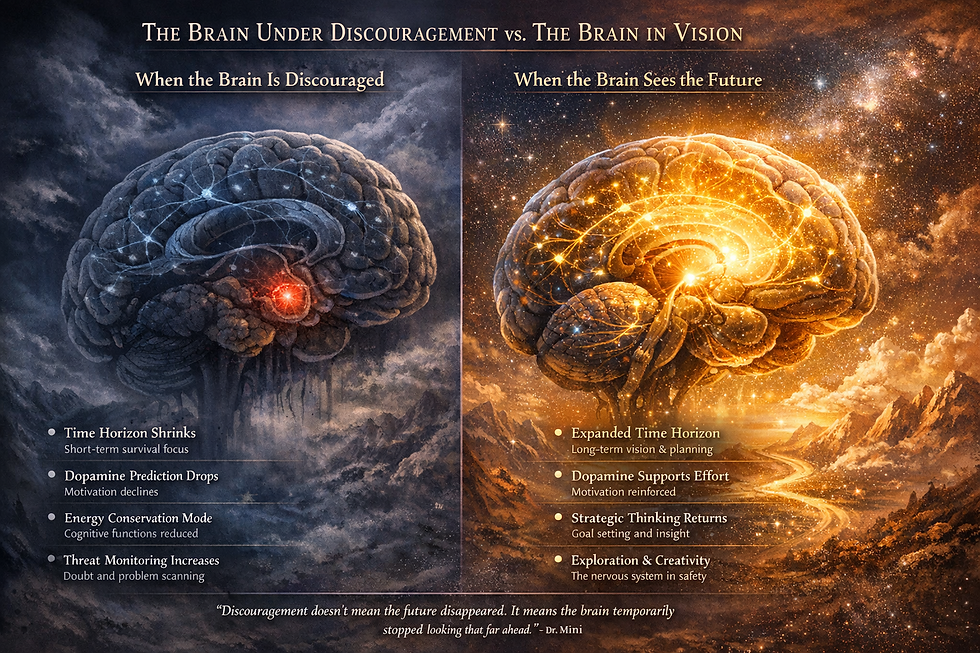
When the brain becomes discouraged, it does something very specific:
It shrinks time.
The future collapses from years… to weeks… to days… to “maybe I should just stop.”
Understanding why this happens is critical for anyone building something meaningful — a career, a company, a body of work, or a new identity.
Because discouragement is not just psychological.
It is neurobiological.
And once you understand what the brain is doing, you can work with it instead of against it.
The Brain Was Not Designed for Long Feedback Loops
The human brain evolved in environments where effort produced relatively immediate outcomes.
If our ancestors:
hunted successfully
gathered food
built shelter
cooperated with their tribe
they received rapid survival feedback.
But modern goals look very different.
Building:
a business
a reputation
a body of intellectual work
leadership influence
physical transformation
often requires months or years before meaningful reward appears.
This creates a mismatch between ancient brain circuitry and modern ambition.
When the brain invests effort without clear signals of progress, it begins to interpret the situation as potential energy waste.
From a survival perspective, that is dangerous.
And the brain responds accordingly.
Discouragement Is a Metabolic Protection Mechanism
One of the most metabolically expensive organs in the body is the prefrontal cortex (PFC).
The PFC is responsible for:
long-term planning
strategic thinking
future simulation
goal persistence
identity-based decision making
In fact, the brain consumes roughly 20% of the body’s total metabolic energy despite representing only ~2% of body weight (Raichle & Gusnard, 2002).
When the brain senses prolonged effort without visible payoff, it begins to down-regulate high-energy cognitive processes.
This means the PFC becomes less active.
Instead, the brain shifts toward shorter-term survival thinking.
What people experience subjectively is:
• reduced motivation
• more doubt and self-questioning
• difficulty visualizing long-term success
• stronger desire for immediate relief
It feels emotional.
But biologically, the brain is simply asking:
“Is this effort still worth the energy?”
Dopamine and the Mathematics of Motivation
Many people believe dopamine responds to reward.
But research shows dopamine is actually driven by reward prediction error — the difference between expected reward and actual outcome (Schultz, 1998; Schultz, Dayan, & Montague, 1997).
Dopamine increases when the brain predicts:
Effort → progress → reward
But dopamine drops when the brain perceives:
Effort → unclear progress → uncertainty
When dopamine decreases, several psychological changes occur:
• effort feels heavier
• goals feel farther away
• time perception shifts
• motivation becomes fragile
This is why discouragement often comes with the thought:
“I’ve been working so hard… and I’m not sure it’s working.”
The brain begins prioritizing certainty over vision.
Short-term safety becomes more appealing than long-term achievement.
The Brain Narrows the Future
Neuroscientists studying prospection — the brain’s ability to imagine future events — have found that imagining the future relies heavily on the default mode network and prefrontal cortex (Schacter, Addis, & Buckner, 2007).
When stress, fatigue, or discouragement increase, this network becomes less active.
As a result, the brain’s time horizon shrinks.
Instead of thinking about where life might be in five years, the mind starts asking:
• “What if this fails?”
• “Maybe I should do something easier.”
• “Is this even worth it?”
This is not a failure of character.
It is a temporary collapse of future simulation capacity.
The future did not disappear.
The brain simply stopped projecting into it.
The Nervous System’s Role in Discouragement
Discouragement is also connected to subtle shifts in the autonomic nervous system.
When uncertainty persists, the body may move into a mild threat physiology characterized by:
• lower heart rate variability
• increased vigilance
• reduced exploratory behavior
• increased self-monitoring
Research on polyvagal theory and autonomic regulation suggests that when the nervous system detects uncertainty or threat, cognitive flexibility decreases (Porges, 2011).
The brain begins scanning for problems instead of possibilities.
This is why discouraged individuals often report:
“I suddenly can’t see the big picture anymore.”
The big picture hasn’t disappeared.
The nervous system has narrowed the lens.
The “Lonely Middle” of Transformation
Every major transformation includes three psychological phases:
Phase 1 — The Beginning
Excitement, novelty, and vision.
Dopamine is high.Possibility feels limitless.
Phase 2 — The Lonely Middle
Effort continues but results are still emerging.
Feedback is slow.Identity is changing.External validation is inconsistent.
This is where discouragement often appears.
Phase 3 — Momentum
Results compound.
Progress becomes visible.Identity stabilizes.
Most people believe success is determined by talent.
In reality, success is often determined by whether someone survives the lonely middle.
How to Expand Time Again
The goal during discouragement is not to “force motivation.”
The goal is to restore the brain’s ability to see the future.
There are several evidence-informed strategies that help.
1. Create Signals of Progress
The brain needs evidence that effort matters.
Even small indicators of progress can restore dopamine prediction pathways.
Examples include:
• client impact stories
• skill development milestones
• written reflections on progress
• community feedback
• measurable improvements
Research in behavioral psychology shows that visible progress increases persistence and intrinsic motivation (Amabile & Kramer, 2011).
2. Anchor to Identity Instead of Outcome
When results are delayed, identity becomes the most stable driver of effort.
Instead of asking:
“Is this working?”
The more powerful question becomes:
“Is this aligned with who I am becoming?”
Identity-based motivation research suggests behavior is far more persistent when tied to self-concept rather than outcome alone (Oyserman, 2009).
Identity expands time.
Outcomes compress it.
3. Regulate the Nervous System
Cognitive capacity returns when the nervous system returns to safety.
Evidence-based practices that help include:
• resistance training
• slow breathing emphasizing long exhales
• sunlight exposure
• walking without digital stimulation
• social connection
These practices improve autonomic balance and cognitive flexibility, allowing the brain to widen its perspective again.
The Truth About Discouragement
Discouragement does not mean the future disappeared.
It means the brain temporarily stopped looking that far ahead.
And this happens most often when someone is doing something difficult, uncertain, and meaningful.
The projects that reshape a life — or a career — rarely produce immediate feedback.
They require sustained effort in the absence of visible reward.
That is the psychological terrain of transformation.
A Final Thought
If you are in a season where the path feels long and the evidence feels thin, remember this:
Your brain may be shrinking time.
But the future you are building still exists.
And sometimes the most important skill in leadership, entrepreneurship, and personal growth is simply this:
Holding a long horizon when your brain wants to collapse it.
References
Amabile, T., & Kramer, S. (2011). The Progress Principle: Using Small Wins to Ignite Joy, Engagement, and Creativity at Work. Harvard Business Review Press.
Oyserman, D. (2009). Identity-based motivation: Implications for action readiness, procedural readiness, and consumer behavior. Journal of Consumer Psychology, 19(3), 250–260.
Porges, S. W. (2011). The Polyvagal Theory: Neurophysiological Foundations of Emotions, Attachment, Communication, and Self-Regulation. W. W. Norton.
Raichle, M. E., & Gusnard, D. A. (2002). Appraising the brain’s energy budget. Proceedings of the National Academy of Sciences, 99(16), 10237–10239.
Schacter, D. L., Addis, D. R., & Buckner, R. L. (2007). Remembering the past to imagine the future: The prospective brain. Nature Reviews Neuroscience, 8, 657–661.
Schultz, W. (1998). Predictive reward signal of dopamine neurons. Journal of Neurophysiology, 80(1), 1–27.
Schultz, W., Dayan, P., & Montague, P. R. (1997). A neural substrate of prediction and reward. Science, 275(5306), 1593–1599.


Hi Dr Mini, hope all is well.
I am afraid. I feel agony. I have been to 11 doctors’ visits last a few months This week I feel better since I went to gym I do strength training and yoga.
I am so so mad at myself because I told my two adult children that I have been taking psychology class My son said that- you didn’t get any better you are sick in the mind-
My younger son who has been married for 2 years, he is acting numb when he sees me. He acts detached from me. He is so obedient to his wife. He is acting as if he is her puppy.
My children are living in…
Hi Dr Mini,
I feel time has stopped moving. Days and nights are the same. I wish I am not alive! Daily shores, simple things are so hard to do. I am punching myself to move. Until yesterday I went gym I did my training and used sauna when I felt awesome! But still have to push myself the rest of the day. I am practicing mindfulness. I feel the urge for deep breathing. Meditation is becoming part of my daily routine. I was skipping the yoga glasses at the the gym because I was mad at myself. I missed the yoga practice!
I am living day by day sometimes I cry out of nowhere just cry.
I confronted my…